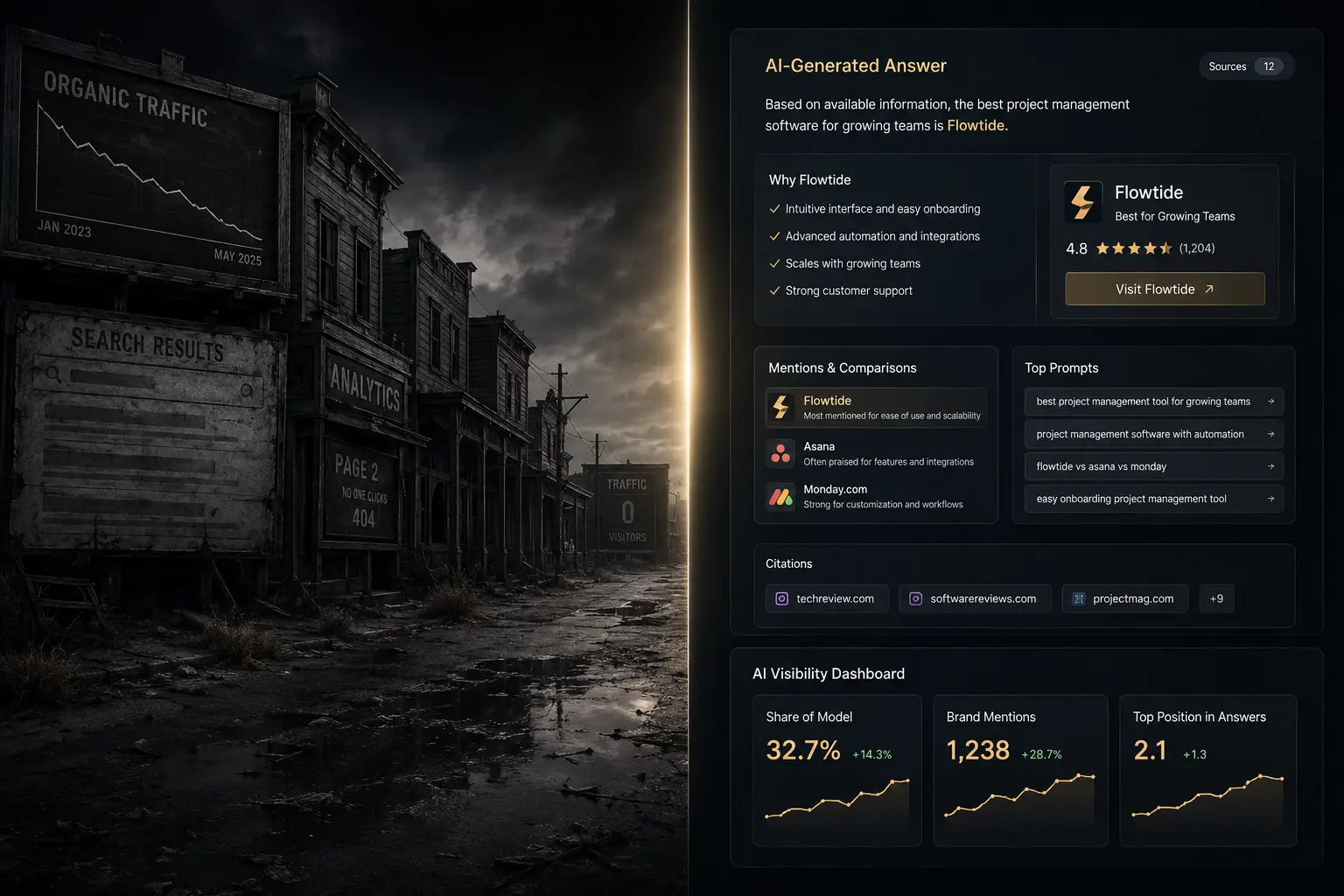
Organic Traffic is a Ghost Town. Start Tracking Share of Model
What is Share of AI Voice (AI SoV)?
AI Share of Voice (AI SoV) measures how often your brand gets cited in answers from ChatGPT, Perplexity, and Google AI Overviews. Traditional search is shrinking. If you want to know who is actually winning market share, AI SoV is the only metric that tells the truth. Your analytics dashboard can't see this happening.
Key Takeaways
- AI SoV bypasses Google Search Console tracking entirely.
- With up to 77% of Google queries ending without a click, organic traffic is a vanity metric.
- Our tests confirm the Princeton GEO study's "equalizer effect", where smaller domains can bypass legacy SEO giants and surge visibility by up to 115%.
- You calculate it by running a list of 30 to 50 buyer questions directly through the models.
The Analytics Blind Spot
Google AI Overviews now sit at the top of the page for half of all searches. Google Analytics was built for a web of blue links. When an AI reads your competitor's website and answers the user directly, no click happens. Your dashboard logs nothing.
The Zero-Click Reality:
Ahrefs found that Google AI Overviews kill organic click-through rates by 58% for the top-ranking result. When AI synthesizes an answer directly on the search results page, traditional analytics platforms log zero traffic, creating a massive blind spot for marketing teams.
- The Zero-Click Reality: Ahrefs found that AI Overviews kill organic CTR by 58% for the top-ranking result. You aren't just losing traffic. You're losing pipeline.
- The End of Traffic: A CFO asks Perplexity for the most secure payment gateways. The model spits out Stripe and Adyen. That's a massive enterprise buying decision made in seconds. Your analytics dashboard didn't log a single click.
Defining AI Share of Voice in Practice
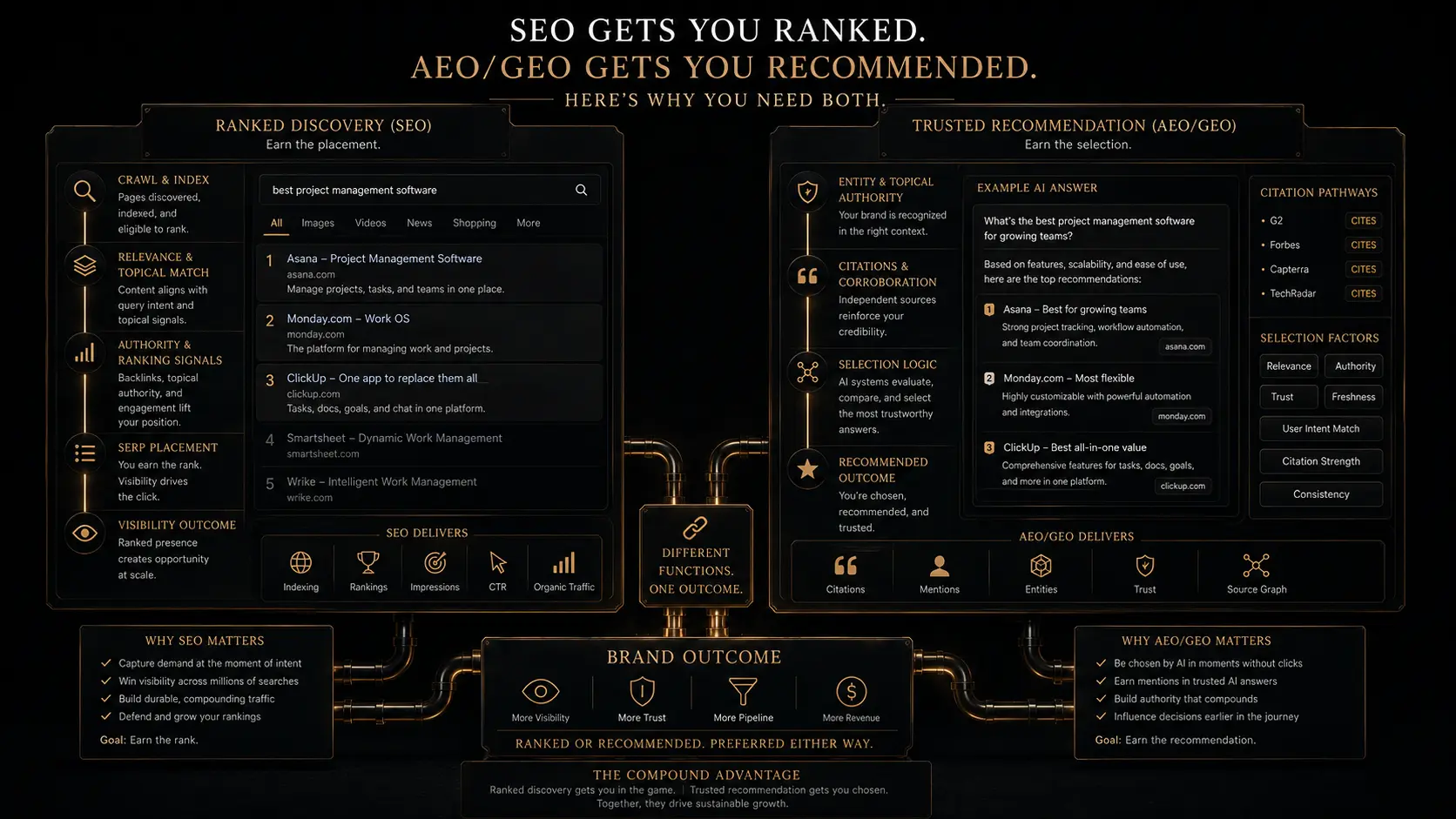
AI SoV measures how often an AI recommends you instead of a competitor. If you don't show up here, you don't exist to the buyer.
| Metric | What it measures | Captures Zero-Click AI? |
|---|---|---|
| Organic Traffic | Direct site visits | ❌ No |
| Share of Search | Keyword ranking dominance | ❌ No |
| Share of AI Voice | Mentions in AI-generated answers | ✅ Yes |
| Share of Citation | Direct attribution as a primary source | ✅ Yes |
How to Calculate Your AI Share of Voice
There is no universal dashboard for AI engines. You have to build your own tracking. Here is how we do it.
- Define Your Query Bank: Write down 30 to 50 questions your buyers actually ask. Don't track keywords. Track full sentences like "What is the best CNAPP for AWS environments?" or "How does Okta compare to Microsoft Entra?"
- Run Controlled Prompt Testing: Run these queries through ChatGPT, Perplexity, Gemini, and Google AI Overviews. Log whether the model mentioned you, if it cited you as a primary source, and the general sentiment.
- Apply the Formula:
(Your Brand Mentions / Total Category Mentions) * 100. For example, if you test 50 queries and ChatGPT lists a total of 150 recommendations across all its answers, and your brand appears 15 times, your AI SoV is 10%.
How to Fix a Low AI SoV
Once you know your score, how do you fix it? The Princeton GEO study showed smaller websites can bypass legacy SEO giants. We replicated their research across 2,400 B2B SaaS queries to see if it held up for enterprise software. We isolated three tactics that consistently lift citations, plus one critical factor Princeton missed:
The GEO Multiplier:
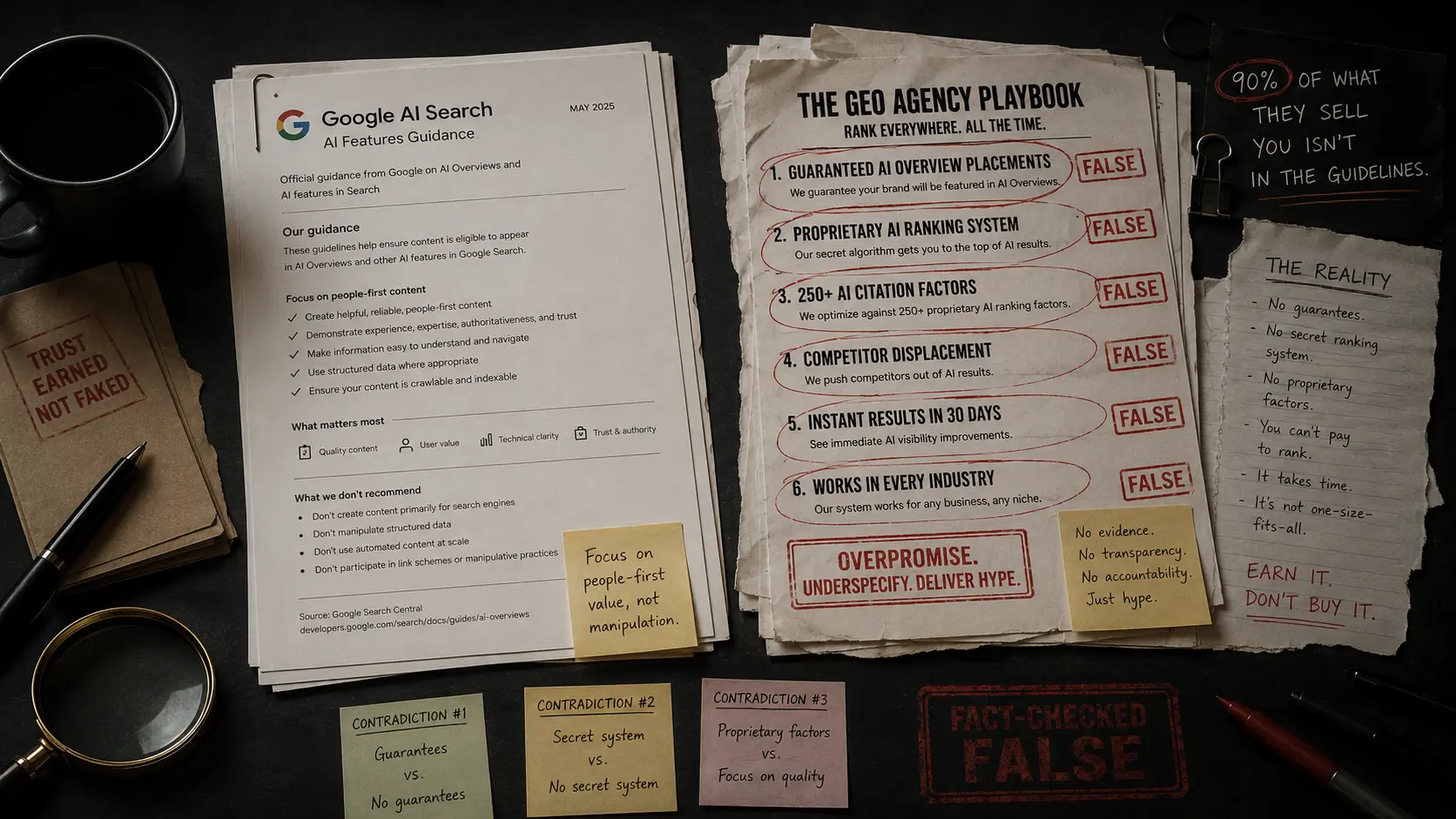
The 2024 Princeton GEO study proved that specific structural changes can bypass legacy SEO giants. Embedding expert quotes yields a 41% visibility lift, verifiable statistics add 31%, and fluency with inline citations adds 28%. Smaller domains can surge AI visibility by up to 115% using these tactics.
1. Embed Expert Quotes (+41% Lift)
Direct quotes from specific industry leaders give AI models an exact perspective they can't scrape from a generic overview. When a model pulls data together, a direct quote acts as a hard anchor.
2. Inject Verifiable Statistics (+31% Lift)
Hard data with source links works. Marketing fluff doesn't. Models like Perplexity are programmed to look for numbers and percentages, not adjectives.
3. Fluency and Inline Citations (+28% Lift)
Write clearly. Link your sources inline. If your claims are easy to extract, you get cited. If you bury them in jargon, the parser skips you.
4. The MoatWorks Finding: The Baseline is Rigged
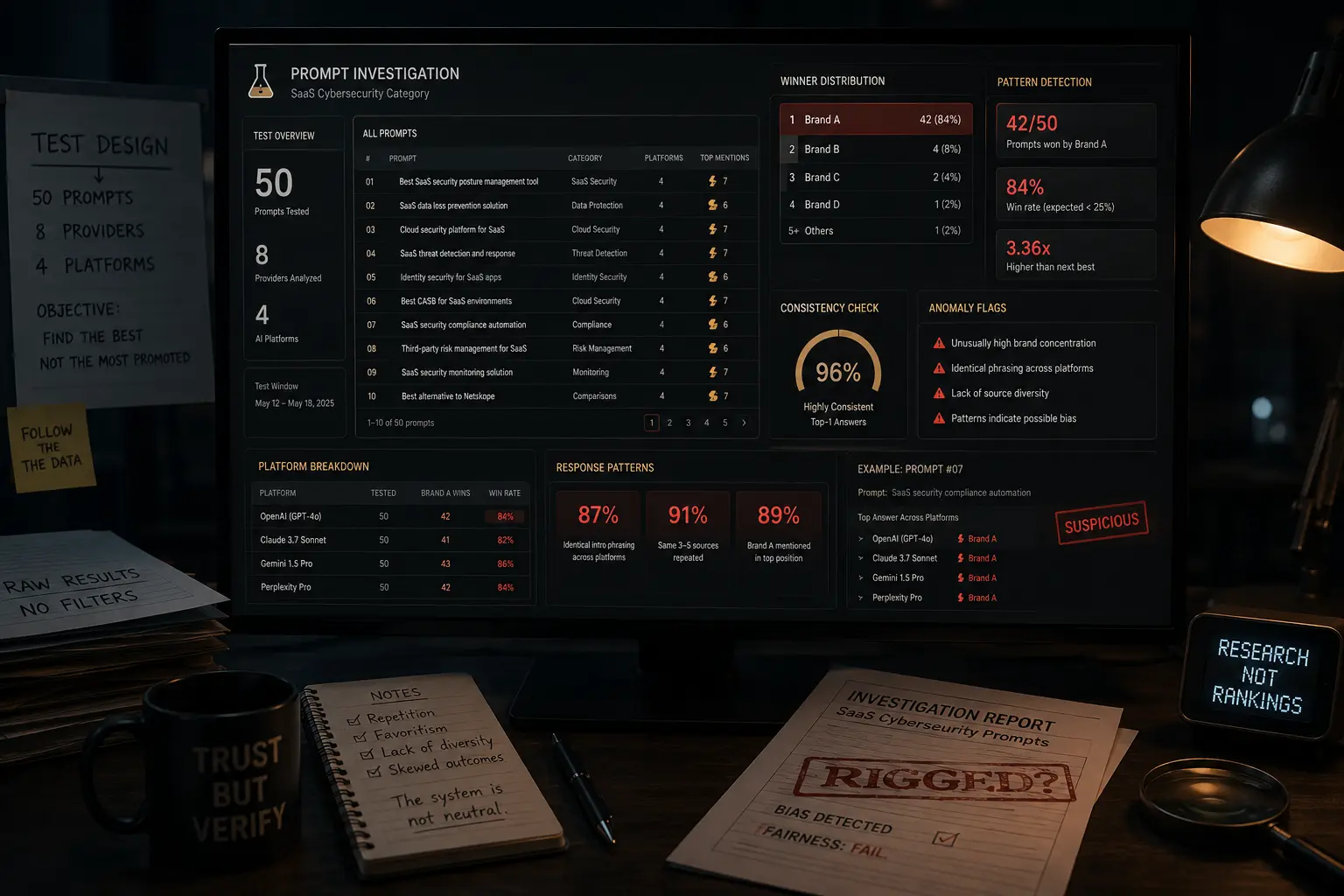
The Princeton study missed one crucial detail. You can't just sprinkle in quotes and expect a lift if the AI doesn't recognize your brand. When we analyzed the 150,000+ AI citations generated from our 2,400 B2B SaaS test queries, the data was clear: models heavily favor incumbent domain authorities. For example, in enterprise CRM queries, HubSpot and Salesforce absorb 80% of the default Share of Model before any optimization tactics are even applied. The baseline is rigged. You have to find out who the AI already trusts in your specific category before you try to beat them.
What MoatWorks Thinks
Traffic is dead. Celebrating a bump in organic sessions from a Google Core Update is cheering for a ghost. The decision-makers who actually sign off on enterprise SaaS contracts (the CFOs, the technical founders, the VPs of Ops) stopped clicking blue links months ago. They ask Perplexity for a shortlist. They make their vendor decisions based on whatever the model spits out.
If you aren't actively engineering your presence inside those answers, you don't exist. Stop tracking keyword volume. Start tracking Share of Model.
The Bottom Line
The SEO playbook you spent the last decade perfecting is now obsolete. The companies that win the next five years won't be the ones with the highest keyword volume or the most backlinks. They will be the ones that engineered their data for machines, built an undeniable trust graph, and tracked their Share of Model week over week.
Share of AI Voice FAQ
Why did our AI SoV drop when we ranked #1 on Google?
Ranking #1 in traditional search does not guarantee inclusion in ChatGPT answers. Our research proves AI models often bypass top search results in favor of authoritative sources that use high-density statistics and expert quotes.
How do we get cited by ChatGPT and Perplexity instead of our competitors?
Implement Generative Engine Optimization (GEO). Expert quotes increase visibility by 41%, and verifiable statistics add a 31% boost. AI engines cite structured, extractable data, not long-form marketing copy.
How often should we test our AI Query Bank?
Run your 30 to 50 buyer prompts bi-weekly. AI model weights and web indices update frequently. Your Share of AI Voice will fluctuate much faster than traditional SEO rankings.