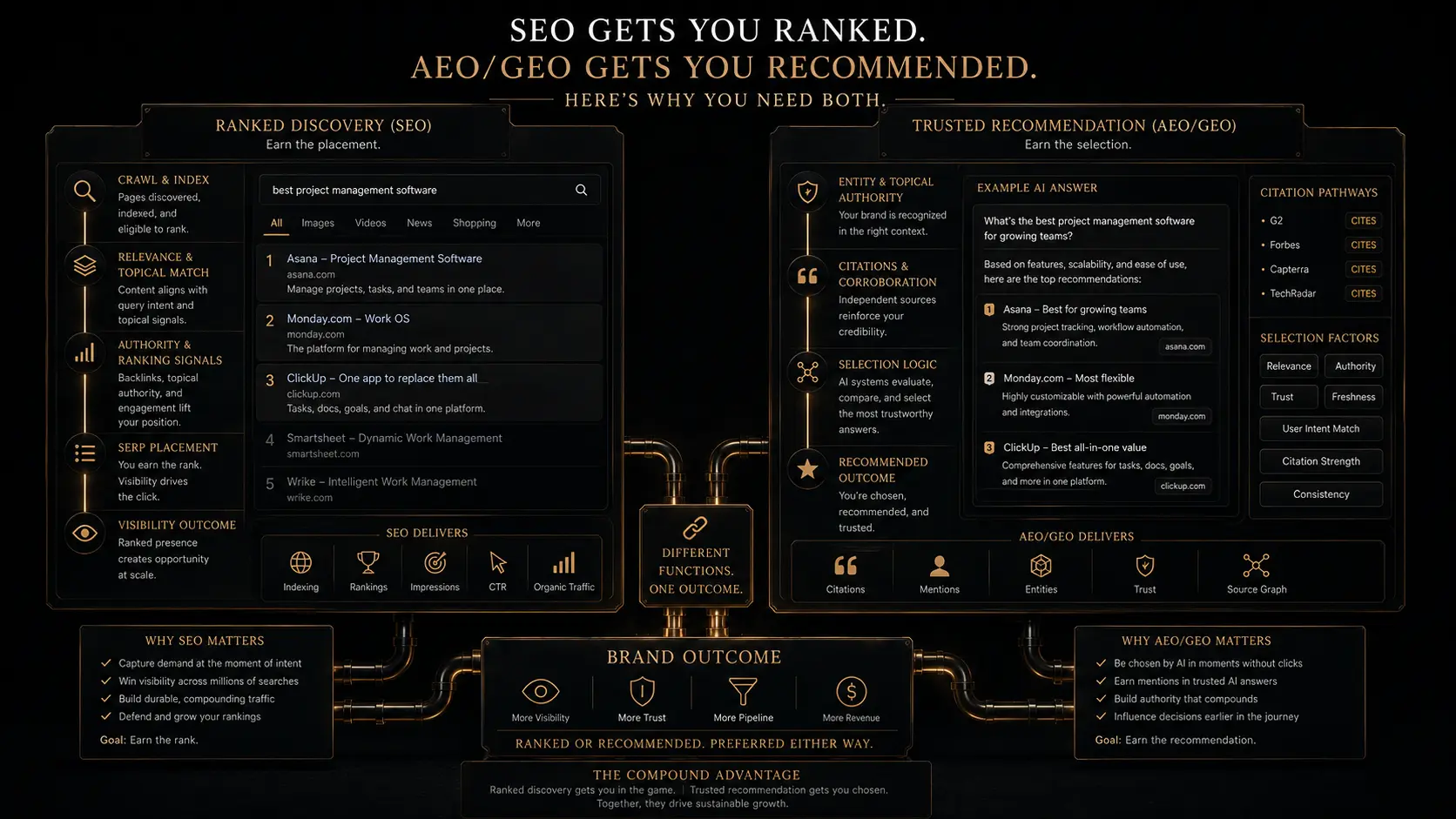
SEO Gets You Ranked, AEO/GEO Gets You Recommended. Here's Why You Need Both
Ranking number one on Google used to be the finish line. You did the keyword research, built the backlinks, tuned the meta tags, and watched the traffic come in. That era is ending. In the first four months of 2026, 68% of all Google searches ended without a single click to an external website, up from 60% in 2024. When AI Overviews appear on a query, click-through rates to organic results drop by roughly 58%.
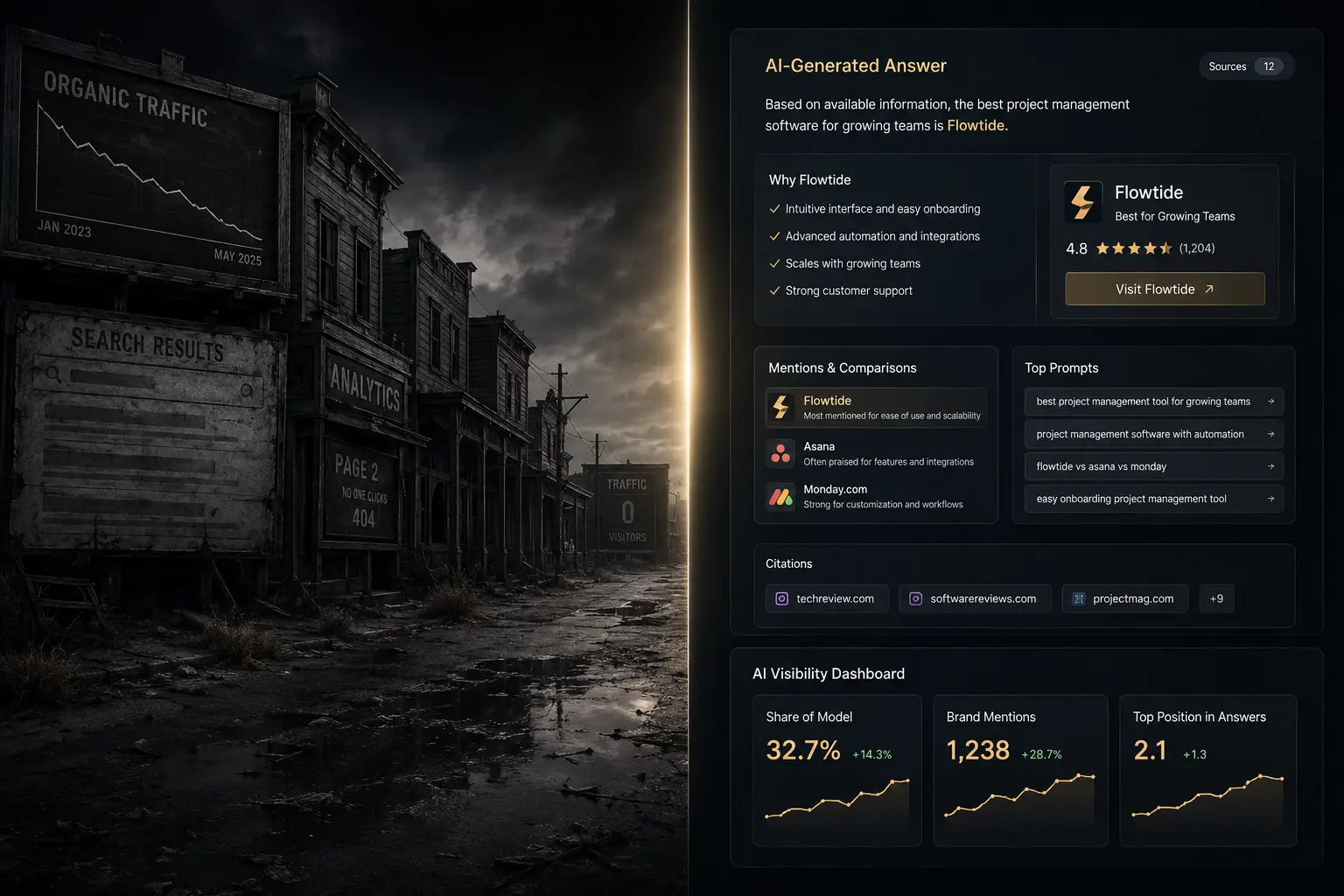
The traffic is not gone. It is being absorbed. AI systems now answer the question directly, and when they do, they cite their sources. The companies that get cited win the new funnel. The ones that only rank, without being structured for AI retrieval, watch their pipeline dry up while their rankings hold steady.
Key Takeaways
- SEO is the indexation layer. Without it, AI engines have nothing to retrieve or cite.
- AEO/GEO is the recommendation layer. It turns indexed pages into sources that AI actually references when answering buyer queries.
- Muck Rack's May 2026 study found that 84% of AI citations link to earned media, and paid content accounts for just 0.3%.
- Princeton's GEO research showed that adding sourced statistics boosts AI visibility by 40%, while keyword stuffing reduces it by 10%.
1. SEO Is Infrastructure, Not Strategy
There is a popular take floating around LinkedIn right now: SEO is dead. The people saying it are usually selling something that replaces it. Here is the problem with that argument. Every AI retrieval system, Google AI Overviews, ChatGPT with search, Perplexity, Gemini, all of them depend on indexed web pages as their source material. If your pages are not crawlable, not indexed, and not ranking, they do not enter the retrieval pool.
Think of SEO as plumbing. Nobody brags about their pipes. But when the plumbing breaks, nothing works. Clean site architecture, fast load times, proper heading hierarchy, semantic HTML, these are not optional extras for AI visibility. They are prerequisites. Google's own AI optimization guide says it plainly: the best practices for SEO continue to apply because generative AI features are rooted in core search ranking systems.
The Prerequisite Layer:
According to Google's own AI optimization guide, generative AI features are rooted in core search ranking systems. If pages are not crawlable, indexed, and ranking via traditional SEO, they do not enter the retrieval pool for AI Overviews or citations.
You cannot skip this step. If your technical SEO is broken, no amount of AEO/GEO work will compensate. The AI cannot cite what it cannot find.
2. AEO/GEO Is the Recommendation Layer
Once your content is indexed and ranking, a separate problem emerges. Ranking does not guarantee citation. We have looked at hundreds of AI-generated responses in B2B SaaS categories, and the pattern is clear: the page that ranks first on Google is not always the page that ChatGPT or Perplexity cites.
AI systems do not copy-paste search rankings. They synthesize. They pull from multiple sources, weigh them against each other, and construct a composite answer. The sources they choose depend on structure, specificity, and third-party validation. A page with a clear, self-contained answer block, sourced statistics, and named expert attribution gets cited. A page with vague marketing copy and a "contact sales" CTA does not.
From the Princeton GEO Study (KDD 2024):
Authoritative citations and specific statistics boost AI citation visibility by up to 40%. Keyword stuffing, by contrast, actively reduces it by approximately 10%. AEO rewards extractability, while traditional SEO rewards keyword relevance.
That is the core difference. SEO rewards keyword relevance and authority signals. AEO/GEO rewards extractability and citation-worthiness. You optimize for both or you optimize for neither.
3. The 84% Problem Nobody Talks About
Muck Rack published their third Generative Pulse study in May 2026, analyzing over 25 million links cited by ChatGPT, Claude, and Gemini across 17 industries. The headline finding: 84% of AI citations point to earned media. Not your homepage. Not your product page. Not your paid ads. Earned, third-party media coverage.
Paid and advertorial content? 0.3%. That is not a rounding error. That is a complete market signal. AI models trust independent editorial sources because they are independently validated. Your corporate blog saying "we are the best" carries almost no weight in a system that checks consensus across the web before generating a recommendation.
The 84% Citation Rule:
Muck Rack's May 2026 Generative Pulse study of 25 million LLM links found that 84% of AI citations point to earned media. Paid advertorial content accounts for just 0.3%. AI models overwhelmingly trust independent, third-party validation over vendor marketing.
This means your AEO/GEO strategy is not just about your own website. It is about building a presence across the sources that AI actually trusts. Industry publications. Analyst reports. Community discussions on Reddit and Hacker News. Real user reviews on G2 and Capterra. When Perplexity answers "What is the best endpoint detection platform for mid-market companies?", it is pulling from those places, not your feature page.
4. How the Two Systems Feed Each Other
This is where most teams get confused. SEO and AEO/GEO are not competing strategies. They are sequential layers of the same funnel.
The Dual Funnel
Drop Layer 1, and AI has no source material to cite. Drop Layer 2, and your ranked pages get skipped in favor of competitors with better structure. Drop Layer 3, and the AI defaults to recommending whoever has the strongest independent validation, which is usually whoever invested in their third-party footprint first.
5. What Actually Moves the Needle
We spent the last six months testing what works and what does not across AI search surfaces. The patterns that produce citations are more mechanical than most agencies admit.
Sourced statistics work.The Princeton GEO study found a 37-40% visibility boost when content includes specific, attributed numbers. Not "studies show" but "according to Muck Rack's May 2026 Generative Pulse report, 84% of AI citations come from earned media." AI models prefer passages they can verify against a named source.
Self-contained answer blocks work. Every major section should open with a 40 to 60 word paragraph that directly answers the implied question. That paragraph needs to make sense if someone ripped it out of context and read it standalone. That is exactly what AI systems do when they generate citations.
Expert attribution works.Named authors with credentials, quotes from practitioners with titles, "according to" framing for claims. The Princeton study measured a 25-30% boost from authoritative attribution alone.
Keyword stuffing does not. It actively hurts. The same Princeton study measured a 10% reduction in AI visibility from keyword-stuffed content. This is the single biggest difference from traditional SEO. In old-school search, keyword density could still help at the margins. In AI search, it is a negative signal.
6. The Practical Split
If you run a B2B SaaS company and want to know where to allocate resources, here is the honest answer. You need both. The question is sequencing.
If your site has major technical SEO problems (broken crawl paths, JavaScript-rendered content that does not server-side render, no sitemap, slow load times), fix those first. None of the AEO/GEO work will matter if Google cannot index your pages properly in the first place.
If your SEO fundamentals are solid and you are already ranking for relevant terms, your next investment should go into AEO/GEO. That means restructuring your highest-value pages for AI extraction, building out your FAQ schema, investing in third-party media mentions, and monitoring your AI share of voice across ChatGPT, Perplexity, and Google AI Overviews.
The companies that will dominate B2B discovery over the next two years are the ones that treat these as one integrated system, not two competing line items on a marketing budget.
What MoatWorks Thinks
The "SEO vs. AEO/GEO" framing is a false binary invented by agencies that only sell one of the two. The data tells a simpler story: you need indexed, well-structured pages to enter the AI retrieval pool, and you need third-party validation plus citation-ready formatting to actually get recommended.
The playbook is not complicated. Fix your technical SEO. Structure your content for extraction. Build a presence across the independent sources AI trusts. Measure your share of AI voice monthly. Skip any of these layers and you leave the door open for a competitor who did not.
The Bottom Line
SEO puts you on the map. AEO/GEO gets you recommended once you are there. Neither works without the other. The 68% zero-click rate and the 84% earned-media citation figure are not projections or forecasts. They are measurements from the first half of 2026. The shift already happened.
The question for B2B SaaS teams is not whether to adapt. It is how quickly. If you want to understand the specific structural patterns that make AI models choose one vendor over another, we mapped those in detail in Why Reddit Outranks Your Landing Page: Deconstructing ChatGPT's Vendor Bias.
Frequently Asked Questions
Is SEO dead because of AI search?
No. SEO is the indexation layer that feeds AI retrieval systems. Without crawlable, well-structured pages ranking in traditional search, AI engines have nothing to cite. The channel is evolving, but abandoning it means cutting off the source material AI depends on.
What is the difference between SEO and AEO/GEO?
SEO optimizes pages for search engine rankings based on keywords, backlinks, and technical signals. AEO/GEO optimizes content for AI systems that synthesize and cite sources when answering user queries directly. SEO gets you found. AEO/GEO gets you cited.
Can I get cited by AI without doing SEO first?
It is possible but very unlikely. AI models heavily rely on sources that are already indexed and ranked by traditional search. Pages with no organic visibility rarely enter the retrieval pool for AI-generated answers. SEO is the prerequisite, not a competitor.