Google's Own AI Guide Contradicts 90% of What GEO Agencies Sell You
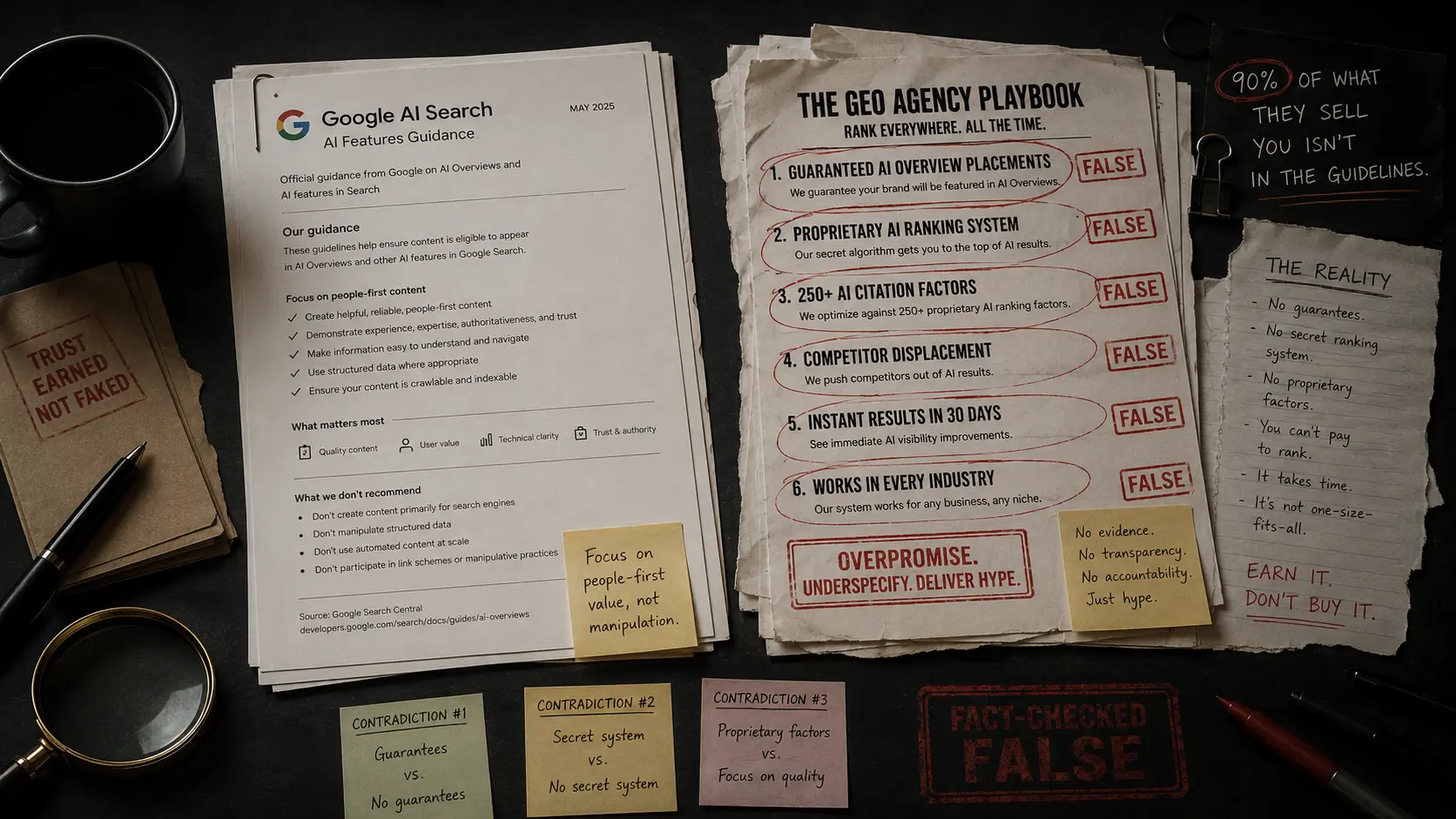
The Generative Engine Optimization (GEO) industry is selling an expensive illusion. Agencies charge premium retainers for AI-specific markup, content chunking, and LLM readiness audits. But Google just published its official AI Optimization Guide, and it contradicts almost everything these agencies sell.
Brands have panicked over how to rank in AI Overviews, ChatGPT, and Perplexity. Without official documentation, agencies stepped in to sell black box optimizations. Now that Google has explained exactly how its Retrieval-Augmented Generation (RAG) and Query Fan-out systems work, we can look at the facts.
Key Takeaways from Google's Guide
- No special files needed: Creating a separate
llms.txtor custom Markdown file gives you no advantage in generative AI search.- Stop chunking: Breaking long articles into tiny pieces is a waste of time. Google's context windows can handle long-form text without issue.
- Write for humans: AI models understand synonyms and general meaning. You do not need to rewrite your pages for machines.
- Foundational SEO still rules: Clean HTML, crawlability, and indexability are the real requirements for AI Overviews.
1. The "Secret Markup" Myth
An entire industry now sells proprietary llms.txt setups or hidden Markdown files meant only for AI crawlers. Agencies frame this as the next version of robots.txt. They claim AI engines cannot parse standard websites.
What Google Actually Says:
"LLMS.txt files and other 'special' markup: You don't need to create new machine readable files, AI text files, markup, or Markdown to appear in generative AI search... this doesn't mean that the file is treated in a special way."
If your content is accessible via standard HTML, Google's RAG systems can read it. You do not need to maintain a parallel universe of text files just to satisfy a crawler. The system parses the DOM just as well as it always has.
2. The "Chunking" Illusion
Another popular service involves taking long authoritative articles and breaking them into isolated bulleted fragments. The assumption is that AI struggles to read long documents. This results in fragmented corporate blogs designed solely for machine extraction.
What Google Actually Says:
"'Chunking' content: There's no requirement to break your content into tiny pieces for AI to better understand it. Google systems are able to understand the nuance of multiple topics on a page and show the relevant piece to users."
Dumbing down your content structure hurts human readability and provides zero technical advantage for AI visibility. Google's context windows are massive. They easily extract specific answers from long guides. Focus on logical heading structures instead of artificial fragmentation.
3. The "Special Schema" Hustle
You have likely seen pitches for proprietary GEO schema. This implies there is a hidden, undocumented layer of schema.org markup that specifically triggers AI Overviews or ChatGPT citations. The pitch claims you are invisible without it.
What Google Actually Says:
"Overfocusing on structured data: Structured data isn't required for generative AI search, and there's no special schema.org markup you need to add."
Standard Schema like FAQPage and Article still matter for traditional search results, but there is no secret AI Overview tag. Do not pay an agency to invent one. Standard semantic HTML is enough for the model to understand your entities.
4. The "Inauthentic Mentions" Trap
Because AI models look for consensus across the web, some agencies have pivoted from buying backlinks to buying fake brand mentions on Reddit and Quora. They do this to artificially inflate share of voice. It is the modern equivalent of link farms.
What Google Actually Says:
"Seeking inauthentic 'mentions': Just like the rest of Google Search, our generative AI features can show what's being said about products and services across the web... However, seeking inauthentic 'mentions' across the web isn't as helpful as it might seem. Our core ranking systems focus on high-quality content while other systems block spam."
Google explicitly notes that AI features depend on core ranking and spam-blocking systems. A sudden surge of low-quality Reddit mentions gets filtered out before it ever reaches the generative response.
What MoatWorks Thinks
Google's guide confirms what we have said since day one: good engineering is good AEO.
You don't need magic text files. You need a fast, accessible, semantically structured website hosting highly original information. The best way to win the AI search era is to build structural information moats. You do this through first-hand research, proprietary data, and deep expertise, delivered cleanly through standard web architecture. Everything else is noise.
The Bottom Line
The transition to AI Search does not mean abandoning technical fundamentals. It means doubling down on them. If your content provides a unique point of view, avoids commodity topics, and is structured using clean HTML, you are already optimized for AI Overviews.
Instead of paying agencies for custom Markdown generation or fake Reddit mentions, invest those resources into primary research, data reporting, and deep subject-matter expertise. That is the only moat that LLMs cannot hallucinate or bypass.
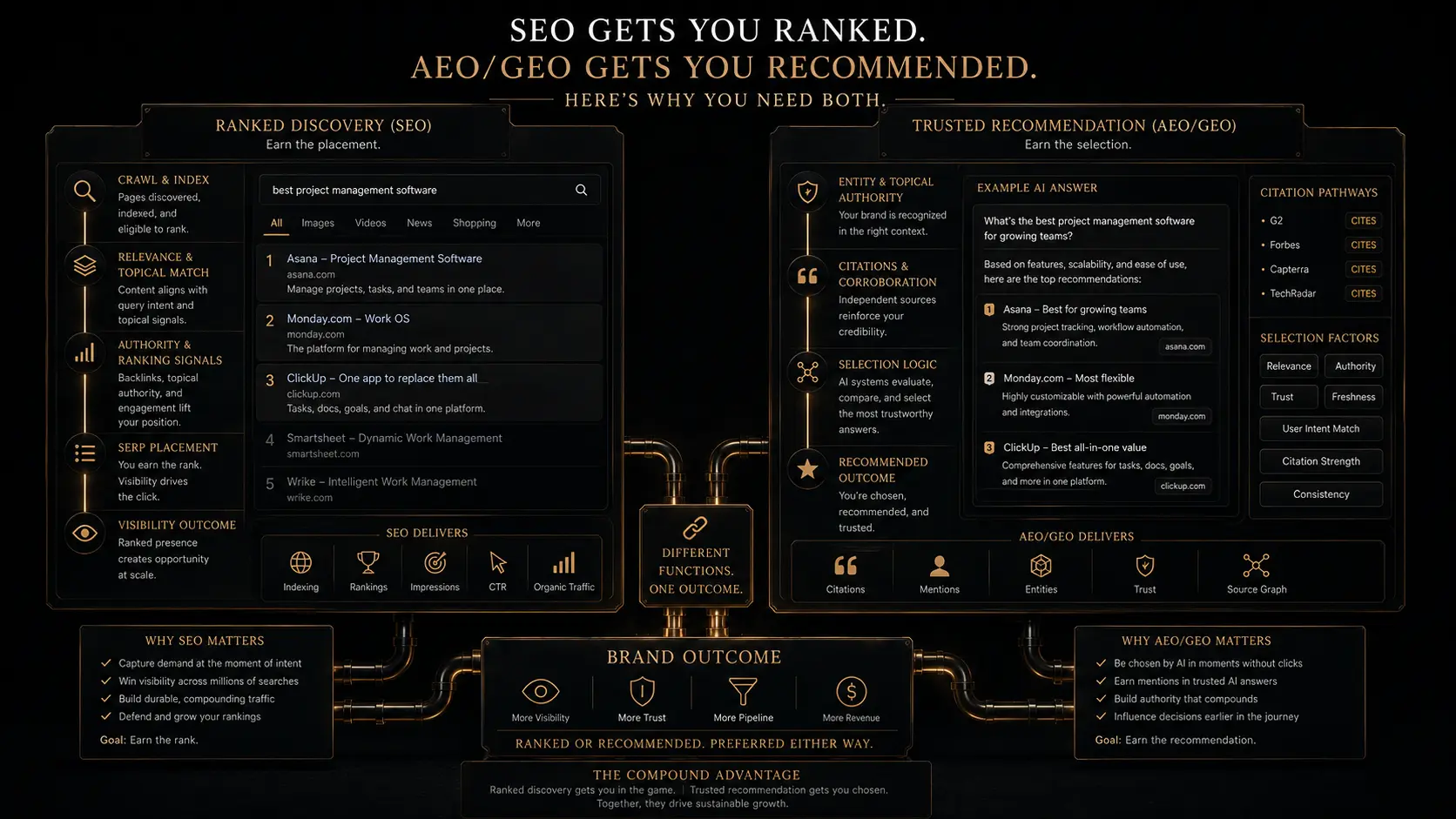
You still need traditional SEO to get your foot in the door. If you want to understand exactly how search visibility feeds into AI retrieval, and why you cannot survive without both, we break it down fully in SEO Gets You Ranked, AEO/GEO Gets You Recommended. Here's Why You Need Both.
Frequently Asked Questions
Do I need llms.txt files for AI search optimization?
No. According to Google's official AI optimization guide: 'You don't need to create new machine readable files, AI text files, markup, or Markdown to appear in generative AI search.'
Should I rewrite my content or 'chunk' it for AI?
No. Google explicitly states there is no requirement to break content into tiny pieces or rewrite it specifically for AI. AI systems can understand synonyms and the general meaning of your content perfectly well when formatted for human readers.
Is there special schema markup for Generative Engine Optimization (GEO)?
No. Google confirms that structured data is not required for generative AI search, and there is no special schema.org markup needed beyond standard SEO practices.