Loading
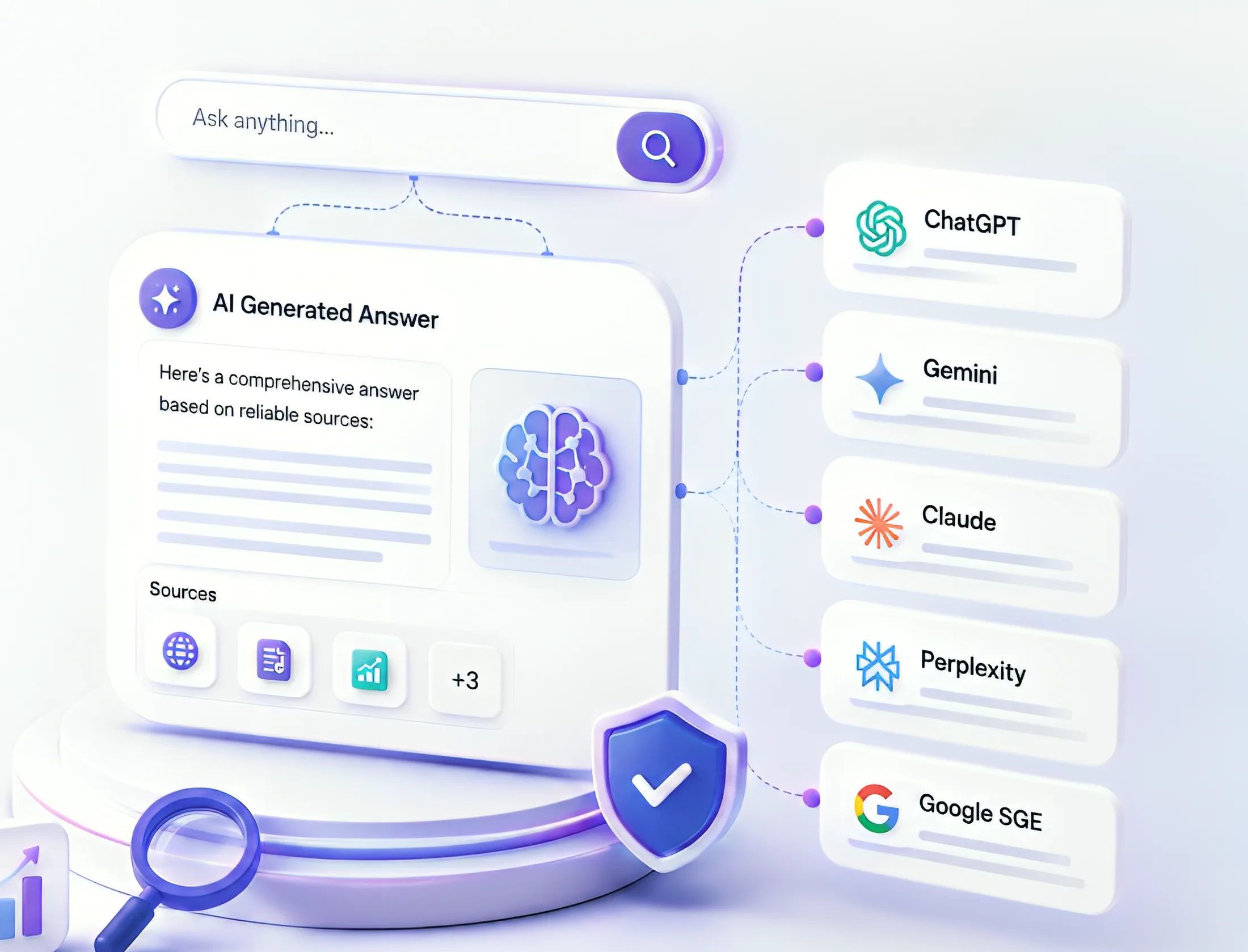
Generative Engine Optimization
Assistants recommend vendors they can verify. We build the record they check.
Covering ChatGPT, Perplexity, Claude, Gemini and Copilot.
What you get08
- Entity Mapping
- Knowledge Graph
- Source Hardening
- Hallucination Fixes
- Moat Score
- Share of Voice
- Source Tracking
- Competitor Watch
What generative engine optimization actually is
Generative engine optimization is the practice of building the external, verifiable authority an assistant draws on when it recommends a vendor.
Assistants do not rank pages. They assemble an answer from sources they already treat as reliable, and they name the brands those sources name. Most of the work is therefore off your own site, because a claim you make about yourself is the single input a model discounts hardest.
Scope
What the work covers.
What generative engine optimization includes
01
Entity Mapping
Before a model can recommend you it has to hold you as a distinct thing: a company, in a category, with products, people and competitors attached. We establish what the models currently believe you are, which is rarely what you think.
02
Knowledge Graph
The structured, cross-referenced record that makes you resolvable rather than merely mentioned. Consistent naming, consistent category, consistent facts across every source that carries them.
03
Source Hardening
Models trust some domains far more than others and the set is narrower than most teams assume. We identify which sources carry weight in your category and make sure each one states the same facts about you.
04
Hallucination Fixes
When an assistant states something false about your pricing, your ownership or your feature set, it is repeating a source. We find the source rather than arguing with the output.
05
Moat Score
A single figure for how defensible your position is across the engines, built from presence, citation share and the quality of the sources naming you.
06
Share of Voice
Across a fixed prompt set, how often you are named against how often each competitor is. This is the number that moves before revenue does.
07
Source Tracking
Which specific documents the engines are drawing on when they answer your category's questions, so effort goes where citations actually originate.
08
Competitor Watch
The same instrument pointed at everyone you sell against, on the same cadence, so a shift in your position can be read against theirs.
Method
Measure, act, measure again.
How generative engine optimization runs
Baseline the prompt set
100+ buyer prompts across five engines, fixed at the outset. Fixing it is what makes every later reading comparable.
Trace the sources
For every answer that names someone, the documents behind it. This is what separates a real citation route from a guess about one.
Harden and place
Correct the sources that misstate you, then earn presence in the ones that carry weight and currently do not mention you.
Re-run and attribute
The same prompts, the same engines, the same protocol. Movement is reported against the baseline or it is not reported.
Distinction
The line between the two
GEO against AEO.
| Point of comparison | GEO | AEO |
|---|---|---|
| Which engines | ChatGPT, Perplexity, Claude, Gemini and Copilot. | Google's own answer layer: AI Overviews, AI Mode, snippets and People Also Ask. |
| Where the work happens | Mostly off your site, in the third-party sources a model already trusts. | Mostly on your site, in structure, formatting and coverage. |
| What is being optimised | Whether you exist as a known entity worth naming at all. | Whether your page is the cleanest available answer. |
| The buyer question it answers | Which vendors should I be considering? | What is this, and how does it work? |
| Time to move | Slower. Authority accrues and cannot be bought in a quarter. | Faster. Structural wins can land in weeks. |
Proof
Measured against a fixed set.
How generative engine optimization is measured
This is the instrument the whole practice runs on, and it is the reason GEO carries more here than the other four services. Every engagement is measured against a prompt set fixed before any work begins, run across five engines on a stated cadence, with the competitor set declared at the same time.
A prompt set assembled after the fact can be assembled to flatter. Fixing it first is what makes a later reading mean anything, and it is why the number sometimes goes down in a report we still send.
The other four services are measured with this instrument. They do not each carry their own.
Moat Score
One figure for defensibility, built from presence, citation share and source quality across the engines.
Share of Voice
How often the engines name you against how often they name each competitor, over the fixed prompt set.
Source Tracking
The specific documents behind each answer, so a change in position can be traced to a change in a source.
Competitor Watch
The same readings for everyone you sell against, taken on the same day under the same protocol.
Questions
Answered straight.
What buyers ask about geo.
By engine. GEO covers the standalone assistants: ChatGPT, Perplexity, Claude, Gemini and Copilot. AEO covers Google's own answer layer. GEO is mostly off-site work on the sources a model trusts; AEO is mostly on-site work on the structure of your pages. Most companies need both, and they are separate engagements because they are separate jobs.
Find out where you actually stand.
A fixed prompt set, five engines, and the competitor set declared before anything is measured. You keep the roadmap either way.